
Amidst the glowing tributes for National Security Advisor Brajesh Mishra, who died last week, it must not be forgotten that he was pivotal to bringing about far-reaching but questionable shifts in India's security and foreign policy stances and forging a hard-line national security apparatus, says Praful Bidwai.

In an exclusive interview, former National Security Adviser Brajesh Mishra argues why he has changed his earlier opposition to the India-US nuclear deal.

Senior analyst B Raman assesses Brajesh Mishra's role as India's first National Security Advisor, his part in the 1998 nuclear tests, the Kargil conflict and more.

Former national security advisor Brajesh Mishra, during whose tenure India-China relations had improved significantly, has said that China's present threat to India is more dangerous than in 1962, when the countries clashed in a war, and that Indian politicians were to blame for India's weak defence position.
Terming the opposition in Parliament over the End User Monitoring Agreement between India and the United States as 'bunkum', former national security advisor Brajesh Mishra said, "We should ask these leaders to address the question: do you want defence equipment from US or not?"He said, "If you want to buy the American agreement, then you will have to agree to the EUMA also. It is up to you to decide what you want."
India's growing strategic partnership with the United States is never going to be easy as New Delhi might have to say 'no' to Washington on some occasions, former National Security Advisor Brajesh Mishra believes.
China and Pakistan are coordinating effectively with each other to keep India engaged in South Asia, believes former national security advisor Brajesh Mishra."There seems to be some coordination between China and Pakistan in order to keep India engaged in South Asia so that India does not play a role in the rest of Asia," Mishra said."China's positioning on the Line of Actual Control has become very aggressive," he added.
For the first time, representatives from India and Pakistan have been invited to the meeting of the newly constituted International Nuclear Disarmament Commission, which is working towards rectifying the NPT to make it more acceptable.

Bharatiya Janata Party President Rajnath Singh on Friday refused to speak on dvani''s role in the Kandahar hijack. " I refuse to say anything on the Advani issue," said Singh.
Isak Swu and T Muivah had a one-hour meeting with the former prime minister at his residence.
'The priority at the moment should be to strengthen our internal security arrangements and improve coordination among the intelligence agencies, state governments and military authorities,' says Naresh Chandra, India's former ambassador to Washington.
'India should act harshly by discontinuing the peace process. The Lashkar-e-Tayiba could not have the kind of capacity to train commandos. The Pakistani establishment's help has to be there to prepare people for such attacks,' says former foreign secretary Kanwal Sibal.
In an interview with CNN-IBN's National Editor Bhupendra Choubey, former National Security Advisor and principal secretary to former Prime Minister Atal Bihari Vajpyee, Brajesh Mishra talks about the recent crisis in National Democratic Alliance surrounding Gujarat Chuef Minister Narendra Modi and his Bihar counterpart Nitish Kumar.
Former NSA Brajesh Mishra told rediff.com, "One knew that the US was in Afghanistan to kill Osama. If they would get him, then their operation will be over. But, I believe the Taliban in Afghanistan is as dangerous as Osama's Al Qaeda. They are having a presence outside Afghanistan as well in Europe and even in the US."
Strategic thinker and former bureaucrat, K Subrhamanyam says that India is not doing enough, just yet, to respond to Mumbai attacks.

Former RA&W chief A S Dulat, who served as Atalji's adviser on Kashmir, gives us an insider's glimpse of a prime minister he has hailed as the 'greatest after Nehru'.

Several officers in the intelligence agencies want the role of the National Investigation Agency clearly defined to avoid lack of cooperation between the Centre and states.

Former National Security Advisor M K Narayanan on Wednesday said that he played no role in the controversial Rs 3,600 crore VVIP AgustaWestland chopper deal.

In the book, Anger Management: The Troubled Diplomatic Relationship Between India and Pakistan, Bisaria says this public telecast sounded to observers like a mid-summit report on the talks, where Pakistan's hard views were being inflicted on India, while New Delhi's positions were unclear.

'There is no link between Article 370 abrogation and a rise in voting percentage.'
'Right now, we have no relationship with Pakistan. And the relationship with China is not great.'

Freedom At Midnight is a bold attempt to revisit the whole discourse about Partition, its causes, and the predicament under which the Congress leaders accepted it. It perfectly captures the extremely confused and complicated situation to which it seemed the only viable solution, observes Utkarsh Mishra.

With India's political wheel turning full circle this year, National Security Advisor Ajit Doval will negotiate from an expanding diplomatic space, writes Ajai Shukla

Ambitious diplomats continue to be attracted to politics but do they make good politicians, asks Jyoti Malhotra

'In his eulogy at Sandy's memorial service, President Clinton recounted the unusually hot US Independence Day, July 4, 1999, when most of official Washington was more interested in watching fireworks than international diplomacy. Sandy insisted that Clinton confront Pakistan Prime Minister Nawaz Sharif in no uncertain terms.' Former US Assistant Secretary Raymond E Vickery, Jr salutes Sandy Berger, Clinton's National Security Adviser, as a true friend of India.
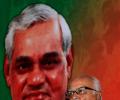
'Advani went by the book, by files, by advice given by his babus. He may be well read and articulate and a pleasant conversationalist, but none of that makes for the kind of creative politician that Vajpayee was.' 'This is the kind of observation about the Vajpayee premiership, more than the promise of espionage or Kashmir gossip, that made writing A S Dulat's book a satisfying experience,' says Aditya Sinha.

Dai Bingguo, who served as the China's boundary negotiator with India from 2003 to 2013, told Chinese media, "If the Indian side takes care of China's concerns in the eastern sector of their border, the Chinese side will respond accordingly and address India's concerns elsewhere."

'It is strange that a country like India, which had gone through crisis after crisis resulting from militancy, insurgency and terrorist attacks, should still be practising ad hocism in managing its security imperatives,' says B S Raghavan, the distinguished civil servant and former member of the Joint Intelligence Council.
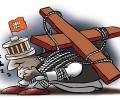
'Poor home work, and a subsequent loss of nerve.' 'This sums up the Modi government's current travails, the stall in key sectors, fading momentum, irritability,' points out Shekhar Gupta.

'The India-France relationship has been that of the elites of two countries, who appreciate each other's philosophical traditions -- whether it is ancient Indian civilisation and Sanskrit texts or the French tradition of Rene Descartes, Albert Camus, (Jean-Paul) Sartre... This is a drawback. It doesn't create the buzz, the excitement necessary for a relationship. We need more people-to-people contact, especially among students,' says former Ambassador to Paris, Rakesh Sood.

Were the May 1988 nuclear tests a success? 20 years after Pokharan, a look back at those decisive atomic tests through the eyes of someone who knew.

'Dulat's professional successors in the game would now find it that much harder to access/create meaningful sources/assets needed for effective functioning in a place like Kashmir. By blowing their cover the former top spy has undone whatever he might have been able to add to his organisation's resource kitty.'
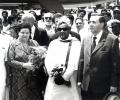
'I was present at a meeting where he decided to permit the IAF to strike at Pakistan positions in Kargil, with the caveat that they should not cross the LoC.' 'Confident that the Indian Army would succeed, Mr Vajpayee was positioning himself to tell the world after the Kargil conflict was won that India did not violate the 'sanctity' of the LoC,' recalls Ambassador G Parthasarathy, who served as India's envoy in Islamabad in that eventful year, 1999.
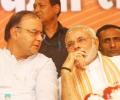
'Nobody would dare directly target Modi, and while there are murmurs about Amit Shah after Bihar, nobody is willing to say this openly. Arun Jaitley, in some calculations, is most expendable for Modi,' says Shekhar Gupta.

'The Modi government's pusillanimity vis-a-vis Pakistan makes almost certain that India will, in the coming weeks and months, be confronted with cross border terrorist actions of increasing intensity,' warns Satish Chandra, former deputy national security adviser.
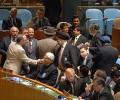
'Under Narendra Modi's leadership, we will be able to regain our rightful place in the community of nations,' veteran diplomat Hardeep Singh Puri, who joined the BJP on January 2, tells Rediff.com's Sheela Bhatt.

"Who will be his men?" a distinguished official close to the prime minister asked. Frankly, nobody has an idea. Hardly seven weeks are left for a regime change, but the idea of Narendra Modi on Raisina Hill looks abnormal, if not unreal. Rediff.com's Sheela Bhatt captures the uncertain mood in the capital's bureaucracy ahead of the largest democratic transfer of power in the world.
